
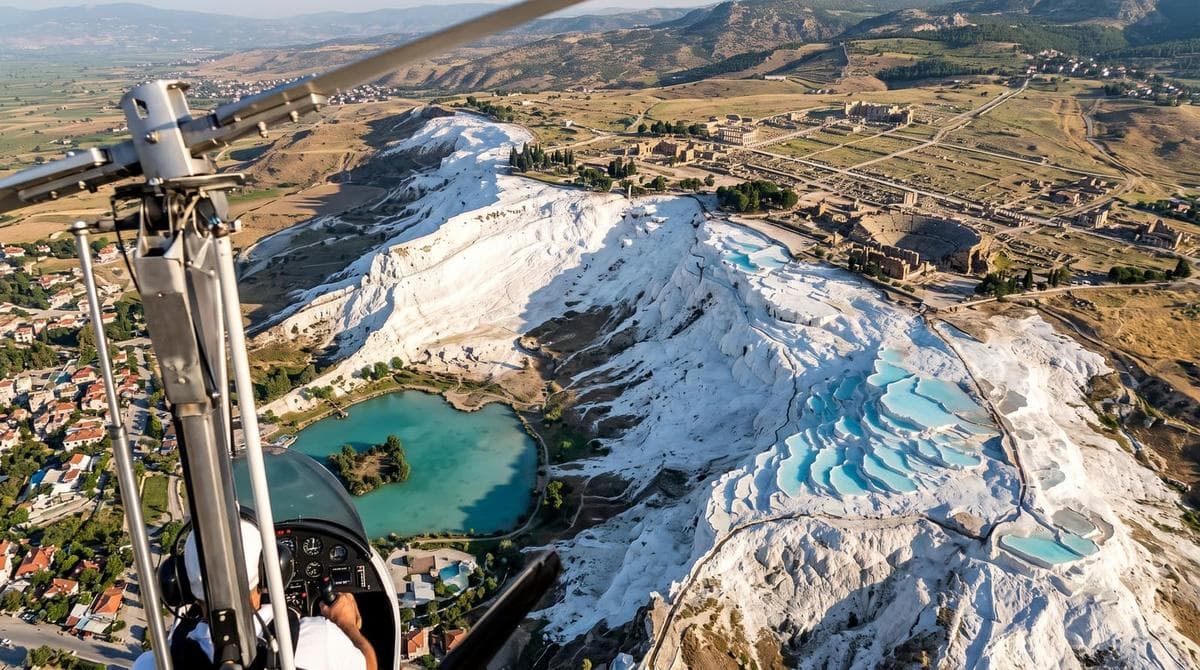
Flying over Pamukkale offers a bird's-eye view of historical details and geological formations that are easily missed from the ground. On a Pamair gyrocopter flight, you will discover the massive scale of the white travertine terraces, the grid plan of Hierapolis, and the surrounding natural wonders. In this guide, we review the top 7 landmarks visible along our scenic flight paths.
Quick Summary: Top Aerial Landmarks
From the open cockpit of the gyrocopter, you will get clear views of these 4 major sights:
- White Travertine Pools: See how the massive walls of calcium terraces and turquoise basins stretch across the hill.
- Hierapolis Roman Theater: Capture high-angle photos of the best-preserved ancient theater in the region.
- Cleopatra's Antique Pool: Look down through the crystal-clear thermal water to spot Roman columns submerged below.
- Kuzey Necropolis: View Anadolu's largest ancient cemetery, featuring thousands of historic tombs stretching across the valley.
7 Sights Visible on Your Flight Route
Our experienced pilots will guide you over the most photogenic spots of the valley:
1. White Travertine Cascades and Pools
From the air, you can appreciate the complete layout of the travertine terraces. The winding white steps look like a frozen waterfall cascading down the hill, filled with turquoise mineral water.
2. Hierapolis Roman Theater
Built in the 2nd century AD, this grand theater is stunning from above. The aerial perspective highlights its semi-circular stone seating and preserved stage design.
3. Cleopatra's Antique Pool (Ancient Pool)
Surrounded by palm trees and green gardens, the pool's thermal water is so clear that you can easily spot swimmers and fallen Roman columns lying on the pool bed.
4. Hierapolis Necropolis (Ancient Cemetery)
Stretching for over two kilometers, the ancient tombs and sarcophagi are impressive from the air, illustrating the historical size of the spa city.
5. Temple of Apollo & Plutonium (Gates of Pluto)
View the foundations of the sacred temple and the Plutonium, the ancient cave site believed to be the portal to the underworld due to its natural toxic gas emissions.
6. Frontinus Street and Main Gates
The columned main avenue of Hierapolis and the monumental Frontinus Gate are visible, revealing the ancient Roman urban city planning.
7. Pamukkale Natural Park Lake
Located at the base of the travertines, this green park and lake look like an emerald green oasis resting beneath the massive white cliffs.
Travel Guide: To learn how to visit these ruins on foot, check out our Things to Do in Pamukkale guide.
Frequently Asked Questions
How close does the gyrocopter fly to the ruins? Our flights operate within the safe altitude limits set by the Sivil Aviation General Directorate (SHGM). This height is perfect for capturing high-detail photos while maintaining safety.
Which flight route includes the ancient city of Laodicea? Our 15-minute Pamukkale Classic route focuses on the travertines and Hierapolis. Our 20-minute Laodicea route and 40-minute Denizli route extend the flight path to see the streets and stadium of Laodicea.
Does the pilot guide us through the sights? Yes. Your intercom headset allows your pilot to describe the history of the landmarks as you fly over them.